jueves, 16 de mayo de 2013

Israeli High Holidays, Women of the Wall, and Shavuot

Yes, I know I have been very lax about posting. But you know what this means? You get three posts in  one! Enjoy!!!

Israeli High Holidays

When an American Jew thinks of the High Holidays, we usually think of Rosh Hashanah and Yom Kippur. However, Israel has a second set of High Holidays, beginning with Yom Hashoah (Holocaust Remembrance Day) and ending with Yom Ha'atzmaut (Israel Independence Day). At HUC, we actually began our commemoration the day before Yom Hashoah, when we watched a movie in Hebrew class called "Biglal Hamilchamah Hahi" (Because of that War). It was a documentary about two singer-songwriters, Yehuda Poliker and Ya'akov Gilad. whose parents survived the Holocaust. The stories were interesting, but the thing that really tied the movie together was the music. A favorite song on mine was called "Afar V'avak"(Ash and Dust) about Yehuda Poliker's mother going back to visit the Salonika, where she was originally from and many Jews were killed or deported to Auschwitz. I'm going to link it here:


I found out later that Yehuda Poliker made an entire album of music that if not directly related to the Holocaust was influenced by the Holocaust. It has the same title as the above song. Check it out on itunes. It's really powerful.

That night, there was a ceremony at Yad Vashem, Israel's Holocaust memorial. It's impossible to get tickets, so I streamed it online. By far the most touching part of the ceremony was the torch lighting. In this ceremony, six torches are lit, each one by a different Holocaust survivor. Before each torch is lit, the survivor tells his or her story. It was amazing to hear all of the stories. This year, one of the torch lighters actually died a few days before the ceremony, and his widow lit the torch. The ceremony was amazing, so I am going to link the Yad Vashem website here. This page contains information about the ceremony, biographies of the torch lighters, the list of names that was read during the ceremony, and even a broadcast of the ceremony itself for those who speak Hebrew or just want to see something incredible.
http://www.yadvashem.org/yv/en/remembrance/2013/index.asp#!prettyPhoto

The next morning, we had a service at HUC. After the service, we all went outside on the street to hear the siren. At 10am, there was a two minute siren, during which there was a moment of silence throughout the entire country. Not only were people silent, the entire city basically shut down for two minutes. Busses stopped. People got out of their cars. It was so moving. We then had a ceremony at HUC put together by the Israeli rabbinic students as well as a couple of my American classmates. The ceremony revolved around the story of a woman who survived the Holocaust and made aliyah, weaved together by music. It was beautiful.

At HUC. It did have fire in it at one point.

The next week was Yom Hazikaron (Israeli Memorial Day). This day is a much bigger deal than Memorial Day in the United States. Most Americans just have a barbecue or go to the beach or something. But here in Israel, army service is required, meaning almost everyone has someone to remember. Therefore, the day is very somber, and the entire country mourns its fallen soldiers. It begins with a siren at 8pm the night before. Still recovering from three weeks of sinus purgatory, I decided to not go to any sort of ceremony. Instead, we watched the siren from Jen's balcony. This time, not every car stopped, though most of them did. There were several ceremonies that did take place around the city, though. The next morning, we had a service at HUC, which I led with Jen and Lori. After that, we went to a local high school, Gimnasia Rechavia, for a ceremony.

The hallway of Gimnasia Rechavia.

The ceremony was well-attended, both by students and by non-students. I assume that most of the non-students were alumni, though we were there too, so there may have been some community members. At 10am, there was another siren. We all stood in silence. After the siren, the ceremony began with mourner's kaddish and the lighting of a torch. The mourner's kaddish was the only religious thing in the ceremony; the rest was secular. To me, that sort of illustrated the intersection of the Jewish religion with secular Israeli society. Throughout the ceremony, the names were read of alumni of the school who had died while in the army. I believe there were 138 total. Possibly more, but that is what my brain seems to remember right now. Between each name reading was either a poem, a song, or both. Unlike in the United States, where we wear black to a memorial ceremony, here in Israel, the dress code for a memorial ceremony is a white shirt and jeans. It makes sense, as Israel's colors are blue and white.

That night, the country transformed for Yom Ha'atzmaut. I can't speak for the rest of the country, but Jerusalem transformed into one giant party. Really. Every city square had some sort of music and/or dancing, and you couldn't even walk down the street without some kid hitting you with his giant inflatable Israeli flag hammer or spraying you with some illegal fake snow stuff. The atmosphere was festive. My friends and I wandered around the city center. There was some fireworks, music, Israeli dancing, and general partying involved. Of course, I got back home and there was even a party going on in the building next door. And, it must have been city-sanctioned, because there were even the police barrier thingies that I saw on all of the other city parties. The entire city was plastered with Israeli flags. I mean, plastered. You rarely get that kind of display of patriotism in the US.

Outside of my apartment building.

Women of the Wall

Many of you have either read in the news or seen on my wall or heard through the grapevine about what went down and Women of the Wall last week, so I thought I would share my own experience. Prior to Rosh Chodesh, a district court made a decision that we were allowed to pray however we wanted. The Attorney General said that he did not approve of the decision but would not try to overturn it. Therefore, we all decided that we were going to wear our talitot and pray our hearts out. We had heard there was going to be some sort of backlash. As I walked to the Kotel on Friday morning, I noticed that there were many Haredi men and girls also walking to the Kotel. When I got there, what I saw was madness. Half of the Kotel plaza was filled with Haredi men protesting. The other half was filled with Haredi girls praying and protesting. There were so many Haredi women that it was almost impossible to get to the women's side. I tried to find Alli, our wonderful service leader who has been doing great work for Women of the Wall all year, but no such luck. Finally, I found some friends. We saw a bunch of police and realized that the service would be happening outside of the women's section. A couple of us (i.e. Jen followed by me) managed to push past the police and get as close to the middle as we could possibly get. The service was beautiful. Because we were not on the women's side, the men were able to pray with us. It is not what Women of the Wall usually does, and I'm not even sure it's what their ultimate goal is since there are many Orthodox women who pray with us, but it was a certainly a silver lining of us not being able to pray on the women's side. This time, instead of going to Robinson's Arch for the torah service, we read from a chumash. The goal is to eventually be able to read from a sefer torah, but for now this was what they decided to do. There was a girl who had a bat mitzvah, so it was very celebratory. I didn't get any pictures of the service or what was going on because, let's face it, I'm way too short, but many of my taller friends did. The entire service, the Haredim were protesting. However, this time, the police were protecting us, not them. In fact, the only people who got arrested were three Haredi men.

After the service, we were told to leave as an entire group. While we were leaving, the police formed a barrier in front of the Haredim so they could not attack us. My friend and I stil got hit in the face by a water bottle, and another friend got hit in the shoulder by a rock (which he kept as proof that the Haredim are in the wrong in this case), but it could have been a lot worse. I made sure to stick with my friends. They made us all exit the Kotel plaza the same way, and we all had to leave the Old City through the Dung Gate (i.e. nowhere near where any of us were going). As we left, we were ushered onto city buses that had been provided for us for safety purposes. The Haredim started throwing rocks at the buses. Good thing we weren't walking. They dropped us off at Mamilla, far away from the madness. I'm not sure how I feel about what happened. On the one hand, it was utter madness. It is completely beyond me why Jews would throw rocks at other Jews, or at anybody for that matter. In the US, this would probably be classified as a hate crime of some sort. On the other hand, this was a HUGE victory for Women of the Wall and for women who want to pray at the Kotel and general. It felt great to be able to wear my talit and not have to worry about getting arrested.

I also want to quickly address the Sharansky plan to fix up Robinson's Arch and make it into an egalitarian prayer space. First of all, that's GREAT. There needs to be an egalitarian prayer space for people who want to do things like have their b'nei mitzvah at the Wall or to be able to pray as a family or with opposite-sex friends or for people who don't fit into the gender binary. However, it does NOTHING to address a huge constituency: Modern Orthodox women. There are women who would like to pray out loud, and maybe even wear a talit if that happens to be their custom (I've seen women in talitot at a couple of Modern Orthodox shuls here, since according to some interpretations it's not required of women but it's not against halacha for them to wear it). There are also women who might not be Orthodox but are simply more comfortable praying only with women. All of these women need a space to pray at Judaism's holiest site. Therefore, it is important that the women's section also be pluralistic and allow all forms of Jewish prayer.

Shavuot

I was lucky to have the opportunity to spend Shavuot in Israel this year. Shavuot is (1) a harvest holiday, (2) the holiday where we received the Torah, and (3) a holiday where you're supposed to eat lots and lots of dairy. Why do we eat dairy on Shavuot? In truth, I'm pretty unsatisfied with all of the explanations I have received, so let's just go with "because dairy is awesome." If that answer is not good enough for you, Rav Google will be happy to help. It is also customary to study torah all night until the sun comes up. This is known as Tikkun Leil Shavuot. Shavuot at home usually consists of some sort of cheesecake smorgasbord with my group of friends, sometimes with other dairy stuff like blintzes or ice cream or just plain cheese, and maybe some torah mixed in there. This year, those HUC students still in the country had a dairy potluck. Everything my friends made was delicious. I of course, made a cheesecake. Then, we davened ma'ariv together, and then it was time for some torah study. Our goal was to get through all five books before 11:30 when all the other programming started, but we only got through Leviticus. We worked in chevrutot (pairs/partnerships) and split up the torah portions, and then we came back together as a group and everyone discussed what they had learned from their portion(s). It was a lot of fun.

After that, some of us there was a program at HUC for young Israeli adults. There were some Israeli rabbinic students there, but there were also a lot of young Israelis who were not really affiliated with HUC. The first thing they had was a song session of Israeli music. Each of the songs had something that could be connected to Shavuot. For instance, there was a song about a girl named Naomi and a song about wearing white. I hadn't heard most of these songs before, so I don't remember the names of them. After that, there were many choices of what we could learn. I chose to go to a session about whether we were all forced to receive the Torah at Sinai or whether each individual's choice. It was awesome, and really interesting to read each mishnaic interpretation. What was even more impressive is that this session was in Hebrew and I understood everything. Then, I needed a change and also thought a nice walk would help keep me awake, so I headed over to Pardes for a session taught by their president. It was interesting. Among other things, we looked at a mishna that examined the different types of leadership and how it related to the laws regarding Shabbat and Chagim.

After that, my friends and I headed to the Kotel. It was pretty much madness there. It was crazier than Tisha B'av, and possibly even crazier than last Friday's Women of the Wall. Therefore, I didn't stay in the Kotel plaza for very long. I walked around a bit and saw lots of people davening shacharit. To be perfectly honest, I didn't know one was allowed to daven shacharit before sunrise. Anyone know what the halacha is on that? I wandered over to the women's side for a bit, but then I had enough, so I pushed my way out of the plaza and met my friends on the staircase above to watch the sun rise. It was glorious. I wish I had gotten a picture. After sunrise, I went down to the archeological part where Robinson's Arch is to daven shacharit. I didn't stay for the entire thing, though, because I was exhausted, and so were my friends. I did stay long enough to hear Megilat Rut (the Book of Ruth), which was nice. This is the first time I've ever stayed up for the entire night to study. It was kind of awesome. Maybe next year too?

jueves, 4 de abril de 2013

Back in the (Former) USSR!

As many of you know, my Pesach (or Passover, or whatever you want to call it) this year was very different from normal. First of all, for those of you who are not familiar with Pesach, it is one of the most important Jewish holidays. It commemorates the Exodus from Egypt. We spend the first two nights having a special ceremony/dinner called a seder (literally, order), and then the holiday lasts seven days if you are in Israel, and eight days everywhere else. During this time, one may not eat anything leavened. There are five specific forbidden grains: wheat, barley, oats, rye, and spelt. One may only eat these grains if they are baked into this terrible pseudo bread stuff called matzah that Jews love to hate.

This year, I spent Pesach in the Former Soviet Union, specifically Belarus, helping some of the Jewish communities there celebrate. This was part of an effort of the World Union for Progressive Judaism called the FSU Pesach project. It's something that HUC students have been participating in for the past ten years.

Before heading to Belarus, all twenty of us who were participating in the project flew to Berlin for a conference. We got there sort of late at night, and unfortunately, our bus driver couldn't find the hostel, so we had to drive around for a while. The good news? We totally missed Obama's visit to Jerusalem and didn't have to deal with road closures or anything. Our first full day in Berlin consisted of a walking tour around Berlin where we saw some of the sites that were connected to either Jewish or communist history. One of these sites was a square where Jews were hung for treason.

But not all of the sites were negative. We got to see the New Synagogue, the synagogue where Louis Lewandowski composed all of his music. If you are Jewish, you probably know some of Lewandowski's music. He is a Classical Reform composer, and wrote a lot of choral things, though today many of his pieces are done as congregational melodies. His most famous piece? The Friday night kiddush. You know that one you learned as a kid? Yup, that's Lewandowski. He also composed a very popular Tzadik Katamar. The synagogue was really cool. It was sort of destroyed on Kristallnacht, and was subsequently reconstructed after the war. Today, it is a museum, and part of it is used for prayer by a traditional egalitarian minyan on Friday nights and Saturday mornings.

Another cool thing we got to see was the Siegessaule (pronounced zigazoila), which a late nineteenth century victory memorial. It was originally located in front of the Reichstag, but the Nazis decided to move it in 1939. Now, you may be asking yourself, "What is the Reichstag?" Well, the Reichstag is a German parliamentary building. It was first used during the Weimar Republic and was later used by the Nazis. After World War II, the building fell into disuse, and East and West Germany each had their own respective parliaments in different locations. After the reunification of Germany, once it was decided that Berlin would definitely be the capital, the Reichstag was renovated.

The second day was spent seeing a few different Jewish cites. One of these cites was the largest and most important Jewish cemetery in Berlin. This cemetery even managed to survive World War II. There are many prominent Jews buried here, including Lewandowski. There were also many regular Jews buried here, including my classmate's great grandfather. After that, we visited the building where the Final Solution was drafted. For those not familiar with the history of the Holocaust, the Final Solution consisted of putting the Jews in death camps and killing them all. The most interesting thing in this now-museum was seeing the actual text of the meeting where the Final Solution was decided upon. It was very unemotional and didn't contain anything relating to morals. It was actually rather practical: "We tried deporting all the Jews, but that doesn't seem to be working, so we're going to put them in death camps instead. Here is who gets to live, and here is who gets to go to the death camps." Scary. Even scarier? It was in a gorgeous neighborhood far outside the center of Berlin. Not somewhere you'd think a genocide would be planned. After that, we went to a deportation site. Most of the Jews at this deportation site were deported to either Auschwitz or Theriesenstadt. On the side of the platform, it listed the date of each deportation, along with the number of Jews deported and the location to which they were deported. After we walked around, we gathered together. I sang El Maleh Rachamim (a traditional prayer to lay the dead to rest), and then we said the mourner's kaddish. Full disclosure: My family came to the United States long before the Holocaust. However, as a part of the Jewish people, I still feel a very strong connection to those were in Europe at that time. In the afternoon, things lightened up a bit. Among other things, we got to see the Volksbuhne Theater, which was where Bertolt Brecht staged many of his plays. The theater geek in me was excited.

That evening, we split off for Shabbat services. Many of us decided to attend a 19th century-style Classical Reform synagogue. It was a total culture shock for me. Most of the music was Lewandowski, and almost all of it was choral. The choir was up in the rafters, not on the bima, and there was an organist. The men and women sat separately, but the women were allowed to sit downstairs, just off to the side. The cantor faced the ark, not the congregation, which is something that I am used to from having prayed in Orthodox synagogues here in Israel. However, I was certainly not used to seeing a cantor in an actual cantor hat (I don't know what it's actually called, anyone else know?). The rabbi gave a sermon having to do with Pesach, but I couldn't really understand it because it was in German. He did explain it to us afterwards: He was comparing a Reform haggadah to a Zionist haggadah. I know that some of my classmates felt that they were really able to pray, but I honestly wasn't for most of it. It almost felt like a concert, except I couldn't see the performers. I wasn't totally surprised by this fact, as I am very much not a Classical Reform Jew, but I'm also not a Modern Orthodox Jew and I'm still feel like I'm praying in places like Shira Hadasha. I wonder if it would have felt more like praying had the choir been on the bima, as I would have been able to see who was praying for me. But I did like the music. One of my favorite parts of the service was when they called the kids up to do kiddush, because it just felt really warm. Yes, they did the Lewandowski one. The rabbi was also really nice and spoke to us afterwards. While this wouldn't be my ideal method of prayer, it was certainly a great experience.

Saturday was mostly spent visiting various Holocaust memorial sites. There were some cool ones. My favorite one was a museum with photo albums submitted by various survivors and the families of those who may not have survived. We also went to the Jewish Museum, which was kind of cool. The one non-Holocaust site that we saw was the Brandenburg Gate. It is a major German monument built in the late eighteenth century. During the partition period, it was next to the Berlin Wall and was therefore practically inaccessible, and it was featured prominently in images of the tearing down of the wall. Other than that, I don't remember much, except that it was extraordinarily cold.

The next day was a travel day, but beforehand, I woke up early to go see the one thing that I really wanted to see that we hadn't yet seen: a large still-standing section of the Berlin Wall. I took the train to a place called the Eastern Gallery, which is a 1.5km stretch of the Berlin Wall that has not been torn down and has been painted with murals. Cool stuff. It was also nice just being by myself. Those who know me well know that I am very much a lone traveler. Travel buddies are fun, but I often like going off and doing my own thing. This has been very easy for me in the past, considering that most of the countries where I have done this have been Spanish-speaking. . . some English and Hebrew-speaking countries too. This is the first country I've traveled to where I didn't speak the local language, but I was fine for the morning, and there are enough similarities between English and German that I would probably be fine if I were to come back here alone.

After that, it was off to Minsk with Alli and Jordan. We were greeted in the airport by Rabbi Grisha, who is the only rabbi in the entire country of Belarus. We were taken to the hotel, where we were introduced to the Educational Director at the WUPJ office, Irina, and our translator, Marina.

Before I go on, a little bit of background information on Belarus. Belarus is not a free country the way Americans would think of a free country. The first president of Belarus was elected in 1994 after the breakup of the Soviet Union, and he has been the president ever since. There have been three elections since then. Every one of these subsequent elections was rigged, and the candidates of the opposition party were jailed. People really don't like the president, but if they speak out against him to the wrong person, they might get jailed. Every government building must have a picture of the president hanging on the wall, whether those who work there like it or not. There are also many laws in place to keep people from protesting. The strangest of these laws is that more than three people cannot walk down the street together. It's also illegal to clap in public. Of course, these laws are not enforceable. The president of Belarus really likes sports, so he invests a lot of time and money into it and builds many sports palaces. Ice palaces are also popular, and there is one in every city. When I say ice palace, I mean something like a skating/hockey rink that is also an arena. It is also illegal to teach religion, and one is technically not allowed to choose a religion until one is eighteen. Therefore, we were told that should anyone ask what we were doing there, we had to say that we were tourists and relate whatever we were doing to culture and tradition, not religion. Despite all of this, Belarus does have modern technology. Smart phones and other gadgets are popular, and people do have access to the outside world and news, though the government does block certain websites. Also, there is a certain degree of respect for the Jewish community, which I will talk about later.

On Monday, Erev Pesach, we took a tour around Jewish Minsk. Most of Minsk was flattened by the Nazis, but there are some interesting memorials to the Jews who were killed. There was also a Jewish WWII-era "hospital." I say this in quotations because they didn't have any sort of tools or equipment to do anything hospital-y, so while in name it was a hospital, in practice it wasn't really. However, it did serve to hide members of the communist resistance. We also saw a lot of the structures that the Soviets put in place. We also saw some structures that used to be Jewish but were taken away from the Jews either by the Nazis or the Soviets, and the Jews did not succeed in getting them back. One of those places was a yeshiva. In the days when this yeshiva existed, those who attended the yeshiva were not allowed to study Chumash (basically synonymous with Torah, but not a scroll), because they were already supposed to know it all. Also, if they did something wrong, their punishment was that they couldn't study past 9pm. Why? Well, all the cool stuff was studied at that time.

After the tour, we helped around the WUPJ office for a bit, which was cool because we got to see the inner workings of the WUPJ. One of the things they are doing is writing a grant for funding for a B'nei Mitzvah program in Gomel. They do not already have a program in place, as they do not have the funding, and a program like this would really help them create strong Jewish leadership for the future.

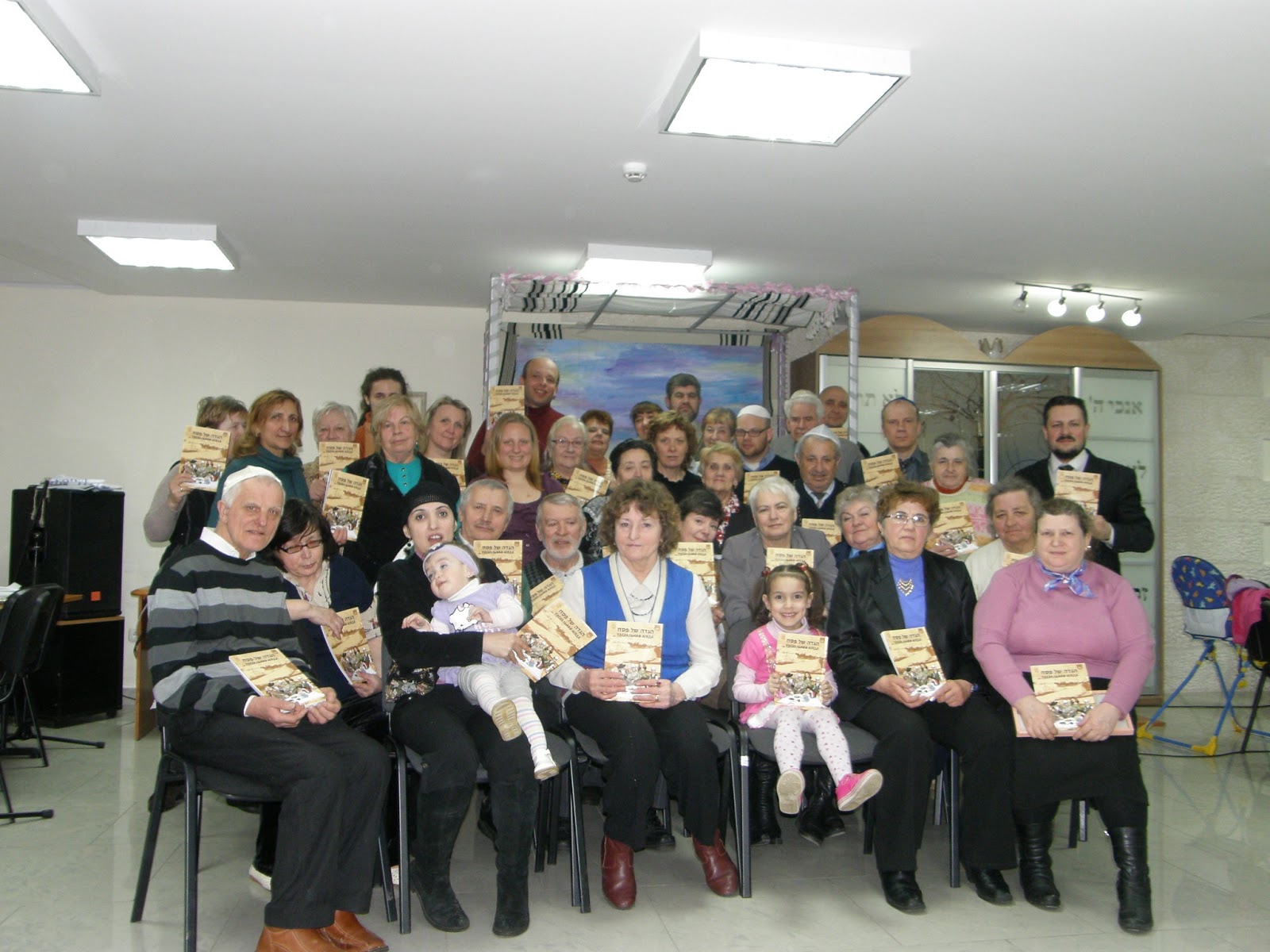
Then, we led a seder for the Sheket (Hebrew for quiet or silent) community, a community of deaf and hard of hearing people. We lead the second half of the seder. Everything we said had to first be translated into Russian and then into sign language, so we had to be very conscious of this. We still did a lot of singing, as there were some hearing people there. They were so warm and welcoming. One of the things this community focuses on is Jewish artwork, and they gave us some beautiful paper cutouts that had been made by members of the community. This was the first time HUC students had led a seder for this community, so they were excited to have us. To explain the background of the picture: This thing was originally a chupa (marriage booth thingy), but now it is used as a sukkah, and also a stage for the Purim shpiel. After the seder, we met with some of the Netzer youth. Netzer is a group for Jewish teenagers and young adults in Russian-speaking countries. So, it's kind of like a combination between NFTY and Hillel. I found them to be highly entertaining.

The next day, we woke up early and hopped onto a train to Baranovichi. I had never seen a train like this before. It didn't remind me of the high-speed train I took to Barcelona from Madrid, or the modern-looking one I took from Santiago to Temuco with air conditioning and a dining car. This one had steep steps to get onto the train. . . annoying with suitcases. . . would also be impossible for someone in a wheelchair. Once in the train, we went to these compartments that had leather seats and beds on top. I can't explain why, but it looked kind of old school. When we got to Baranovichi, we went to our hotel. Our hotel was from the Stalin era and had not been renovated since (though it did have wifi). Our hotel rooms had living rooms, complete with a china cabinet. After settling in and eating lunch (with a very limited option of breadless veggie stuff. . . I miss LA), we went to a museum that told the history of Baranovichi. Baranovichi is a relatively new city, and it was founded because of the railway. We learned lots of interesting things, such as how Belarus used to be one big country combined with Poland and Lithuania. There was also a small part of the museum that talked about the Pale of Settlement (the place where they made all the Jews go so they wouldn't have to live with them, think shtetls and Fiddler on the Roof). There was a lot commemorating the Great Patriotic War, which was the German-Soviet war at the end of the Nazi occupation. There was also a section on modern Baranovichi. They are very proud of their university, and as it turns out, they're the wind music capital of Belarus. Also, their bird is the stork.

That evening, we led a seder in the Jewish community center. This was the most warm and welcoming community I have ever seen. We were able to get many members of the community involved in the seder. We had some people read some parts in Russian. We also got some kids to read the Four Questions and the Four Sons. We also did a lot of singing. There was a guy with an accordion, and every time we sang something he knew, he played along with us. At one point, we were singing Dayenu, and we noticed a table of people singing something different from us. So, we stopped singing, and it turned out they were singing Dayenu in Russian. AMAZING. I did get to lead kiddush, which made me happy because I've been leading kiddush at my family seder basically since I learned the festival kiddush like 18 years ago, long before I was ever in charge of our seder music, and long before being a cantor was ever on my radar (one of my friends commented that I lead a very good kiddush, and this is why), so it was like being at home. Kheel family seder attendees take note: This crowd not only completed the entire seder (rather than wandering off and making me and Aunt Leslie collect everyone and tie them to the table), they enjoyed it! AND, they stayed around and sang for a while afterwards. In fact, the guy with the accordion and the people at his table led something of a song session. It was cool because a lot of the songs they did were Israeli or Hebrew, and so I was able to sing along. I actually kinda wish I could come back here every year.

The next day, we visited the Baranovichi local council building (like a city hall). It was really interesting because they kept showing us that they have the latest technology and talking about how anyone who wanted could come in and get all of their questions answered. It all seemed so, err, sterile. We also found out that they are very nice to the Jewish community, and that Sofia, the leader of the Reform community, even gets invited to city councils. In the afternoon, Sofia gave us a tour around Jewish Baranovichi. Lots of Holocaust-related sites, things like the entrance to the Baranovichi ghetto and a place where a bunch of Jews were taken out of a train and shot. Also a building that was once a yeshiva and is now a gym. Very uplifting stuff. There was a building commemorating a Polish woman who was a righteous gentile, and it seems like the Jewish cemetery is still in tact, so it is not all bleak. In fact, like I said, the Jewish community seems to be doing okay. Later, we met with some of the Jewish youth of Baranovichi. I think the youngest was around ten and the oldest was around twenty-one. They don't quite have enough people of the right age to start a Netzer branch, but they're getting there. They were all very sweet. Hopefully, I will keep in touch with some of them.

The next day, we headed back to Minsk. First, we went to a Jewish school for a concert. It was really interesting because it was like a school within a school. That is, it was something of a Jewish section within a public school. Fascinating. We each sang two songs for them. We mostly stuck with fun Pesach and camp-style songs so that they could sing along. Then, the students sang and played music for us. They were also so talented. I was quite impressed with their knowledge of Jewish and especially Israeli music. There was this one first grader named Liara who sang a medley of "S'vivon" (a Chanukah song), "Chag Purim" (a Purim song), and "Dayenu" (a Pesach song). Cutest thing EVER. There were also a couple of students who played the balalaika. It was my first time ever seeing a balalaika. For those of you who have also never seen one, it looks like the picture on the left. So, kind of like a guitar, but not. For the grand finale, they sang one of my favorite Israeli songs, "Halleluyah," in both Hebrew and Russian. Ben Z, if you happen to be reading this, there were like four modulations, and I totally thought of you.

In the evening, we sang in a cantorial concert. It was awesome. They streamed it. You can watch it here (I had trouble getting it to embed). If you are pressed for time, I sing around 0:43, 1:13, and then we do a trio toward the end. However, you really should listen to all the songs. There were some Netzer youth who sang, and they were AMAZING. Also, Liara, my favorite Belarusian first-grader, sang her medley at the beginning.

Then, we evaluated the trip, and early the next morning, we got on an airplane to go back to Israel. We were originally supposed to have a two-hour layover in Russia. However, whoever the travel agent was forgot to tell us that we needed Russian transit visas. We really didn't want to get stuck in Russia, so they rerouted us through Vienna, which meant a 6am flight and a four hour layover. Either way, it was nice to be back in Israel. At the end of the seder, there's a line, "L'shanah haba'ah birushalayim," which means, "Next year in Jerusalem." I'm glad I got to fulfill this for at least part of the holiday. Pesach food in Israel is nuts. They have, I kid you not, kosher for Pesach BREAD. Huh? It didn't taste like real bread, but I almost felt like it defeated the purpose. At least it was easy to eat out, which was good because I came home to no food. I mean, it's also easy to eat out in LA because they're big on salad and some restaurants serve matzah. . . It wasn't quite as easy to find kosher for Pesach vegetarian food in Belarus, but I managed just fine. The bread thing is still cracking me up. Not that I tried it, but my friends told me the also found kosher for Passover pasta in a few restaurants. Wow. Also, as I mentioned, Pesach is only seven days in Israel, so I got to break it a day earlier than normal. Woohoo!

Anyway, my holiday experience was wonderful, and I wouldn't trade it for the world. L'shanah haba'ah b'Los Angeles!

sábado, 16 de marzo de 2013

Kippot

Now that I'm officially future clergy, I've been trying to find ways to deepen my Jewish practice. One of the things that I have been doing is wearing a kippah (Jewish head covering) at times when I am not praying. I don't wear one all the time; just a lot more often than I used to. I'm not quite sure how I feel about this practice yet. Does it really deepen my connection to G-d? I don't know yet, which is why I'm still experimenting with wearing it more often and not just wearing it 24-7. One of the things that I have been doing is that if I put it on to daven shacharit (pray in the morning. . . something I've been trying to do more of anyway, though it's hard to get up because I'm not a morning person), I'll just wear it all day. Since we have a communal shacharit at HUC on Thursdays (i.e. praying doesn't require me getting out of bed any earlier than normal), I end up always wearing my kippah all day on Thursdays. While no one would look twice at a woman wearing a kippah in Los Angeles, in Israel, whether I like it or not, it's a political statement. Last Thursday night, I had a late rehearsal for a concert about women's rights as they pertain to religious pluralism in Israel. Good stuff. It's chamber style, which is something I want to be doing more of anyway. Singing first soprano, which should only surprise those who haven't heard me sing for a while. Anyway, rehearsal ended at 10, and there was no way I was cooking dinner that late, so I decided to stop at Burgers Bar (never fear, I am still a vegetarian, they have a great portobello mushroom sandwich). The following conversation happened between me and a cashier.

Cashier: You're a girl, and you're wearing a kippah.
Sara: Yes, of course.
Cashier: But why?
Sara: Why not?
Cashier: It's weird for women to wear kippot.
Sara: But I'm Reform.
Cashier: What's that?
Sara: It's kind of like religious, but egalitarian. (Side note: I don't mean to offend any of my friends who are more traditional than I am; this was the only way I could come up with to explain it on the fly to an Israeli who has never heard of Reform Judaism, in Hebrew nonetheless.)

Then, a young guy wearing a kippah came up to me.

Young Guy: You're wearing a kippah?
Sara: Sure.
Young Guy: Why?
Sara: Why not? Women can wear kippot too.
Young Guy: It looks nice.
He then put another kippah on my head over the one I was already wearing and told me to keep it.

I must reiterate: This would NEVER happen in Los Angeles. In LA, I used to lead Saturday morning minyan at my shul and then go out to lunch while still wearing my kippah, sometimes even to Israeli restaurants, and no one would say anything to me because no one cares. I feel like there's this perception in Israel that in order to be a religious Jew I must be Orthodox. But Jews come in all shapes and sizes and observance levels, and it kind of bothers me that a woman wearing a kippah in public is virtually unheard of in this country. If your understanding of Judaism leads you to believe that women shouldn't wear kippot, that's fine, but my understanding of Judaism leads me to believe that it's wonderful for women to wear kippot, and that should be fine too. I want to connect to G-d too! I want to wear a kippah and pray with a tallit, and if that doesn't fit into someone else's schema of Judaism, how is that my problem? My Judaism is no one else's business, unless I'm somehow personally affecting you (i.e. I use my religious beliefs as a justification for beating you up or personally insulting you or something). Why can't I just walk around Jerusalem in my kippah and not have anyone comment or look at me like I'm an alien?

Anyway, in a few days, I'm leaving for Berlin for a conference, and then Belarus to lead Pesach programming. I will be leading seders in Minsk and Baranovichi, as well as leading Pesach music for elementary school kids and singing in a cantorial concert in Minsk. I'm going as part of the Former Soviet Union Pesach Project, which is run by the World Union for Progressive Judaism. I am beyond excited. I will make sure to post after the trip is over.

viernes, 1 de marzo de 2013

Purim!!!!!!!!!!!!!

A lot's been going on here recently, which is why I've been so lax about posting. But I wanted to talk about Purim. Purim is one of my favorite Jewish holidays, because it's basically an excuse to dress up and party. Hooray! If you don't know the story of Purim, you should check it out. I'm linking the Chabad website because it has more than one version:
http://www.chabad.org/holidays/purim/article_cdo/aid/1473/jewish/The-Megillah.htm
So, yeah, awesome story with the theme of "they tried to kill us, we won, let's eat." And when we read Megillat Esther (the scroll with the story of Purim), we get to use these awesome things called groggers in order to blot out Haman's name.
If you forget your grogger at home or don't have one, never fear; you can always boo, or hiss, anti-Stanfurd style. And you know what's even cooler about Purim? We get to eat hamntaschen, or oznei Haman in Hebrew (literally translates as "Haman's ears"). They're these delicious triangle-shaped cookies that are supposed to look like Haman's hat. . . or ears if you're Israeli. In the US, they're usually filled with jelly or poppyseed, but here they have such interesting flavors as date and halva.
Now that you are all as excited about Purim as I am, let me tell you how it was in Israel. The Friday before Purim, Max and I headed to the elementary school where we songlead to go sing some Purim songs with them. Well, the songleading part didn't really work out as planned, but the kids looked awesome, and we got to experience what Purim is like at an Israeli school. The costumes were really elaborate. Think Halloween in the US, but on steroids. Apparently, they had dressed up every day that week, with each day being a different theme, and then Friday was a free for all. WHAT!?!?!?! When I went to Jewish day school, they only let us dress up for ONE day!!!!! Their were some really cool costumes. One kid dressed up as a falafel pita. Another kid was an Israeli astronaut. There were a lot of clowns. And there were definitely some costumes that would have been considered politically incorrect in the US. It was also the loudest assembly I've ever been to, but it was still really fun.

On Saturday night, a bunch of us went to Modi'in to read Megillat Esther at a progressive community there. That was a lot of fun. Kind of crazy, though. Lots of cute little kids running around. I can't explain why, but the experience felt very Israeli. It was just totally different than reading the megillah at Temple Judea or Hillel or wherever else I've ever spent Purim. . . actually last year was Ikar I believe. . .  The costumes were so cute. My favorites had to have been where the parents dressed up their babies. So cute!

Since Jerusalem is a "walled city" (well, only a very small part of it, but close enough), we celebrate something that is called Shushan Purim, which basically means celebrating Purim a day late, so we had an EXTRA day of Purim. Yay! On Sunday night, we read Megillat Esther at HUC. Here is a ridiculous picture of me chanting. It's on Facebook, but I realize that not all of my family members have Facebook. . .
I don't actually know what's happening in this picture. It just is and we shall have to let it be. Before we heard the megillah, we had a ma'ariv service. Led by puppets. Really. A Chassidic guy puppet and a camel puppet. The camel puppet acted as the cantor. It was so ridiculous that it was amazing. After the megillah reading was over, we had the Purim Shpiel, which was Michael Jackson-themed. Among other things, I got to play Teresh, one of the evil servants plotting to kill Ahashverosh, and sing "Smooth Criminal." Someone videoed it, and when I find out where it is, you will get to see it. We also had an HUC party afterwards that was a lot of fun. I did go out for a bit afterwards just to see what Purim in Jerusalem looked like, but I didn't stay out for very long because Sunday was a big day. In any case, Purim in Jerusalem is a bit nuts. Almost too nuts for me, so it's a good thing I didn't stay out too long.

On Sunday morning, I woke up bright and early to chant Megillat Esther at the Kotel with Women of the Wall. It was my first time EVER chanting anything at the Kotel, and I was shaking in my boots. I got to read the entirety of Chapter 6. The anticipation of reading was killing me. I didn't know how I wanted to do it. Did I want to get through it quickly? Or did I want to be expressive? Did I want to chant loudly or quietly? What would happen if they were to arrest me? But it all worked out fine, and I am SO SO SO SO SO glad I did it. I'm going to post the video of it here. If you have your own copy of Megillat Esther and want to follow along, note that my trope is not entirely correct since I was nervous, but I am still beyond proud of myself.

After that came my favorite part of Purim: hanging out with the wonderful and amazing Dana, who I had not had the pleasure of seeing since last June. We got to eat delicious food, I got to meet one of her college roommates, and we played major catchup. We unfortunately forgot to take a picture (I blame the blond hair. . . I know I use that excuse way too often, but it's so convenient). It was so refreshing to have one of my closest friends from home here in Israel. And it was especially amazing because (friends in LA, please don't hate me), I have a job for this summer and probably will be spending all of two weeks in LA.

Anyway, ta ta for now! Someone please get on my case about posting more often.

jueves, 31 de enero de 2013

Hooray for Politics! And Debbie. And Maybe Life Too.

Israeli elections happened last week. The powers that be divided our class into groups and sent us to various cities. My group went to Bat Yam, which is a beach town that is sort of near Tel Aviv, but way more impossible to get to. Then, we had to make a video about it and put in on Youtube. Here's ours. It's about half English, half Hebrew. The part where I explain how the elections work is in English, so even if you don't understand a word of Hebrew, you should watch it.


Now, people keep asking me, "Who is this Yair Lapid guy we keep hearing about?" Well, he is an Israeli talk show host and newspaper column writer (journalist?). He started a new centrist political party called Yesh Atid (There Is a Future), and he won 19 seats in the Knesset (Israeli parliament), which put him in second place, a big achievement for a brand new political party. It remains to be seen whether Yair Lapid and his party would be willing to join in Bibi Netanyahu's coalition and become part of the government. A lot of people seem to think that he will, since it is in his best interest if he wants to have a shot at winning the next election. The last centrist party that won a lot of seats, Kadima, did not join the coalition and is now more or less irrelevant.

These last couple of weeks have honestly been a bit stressful. Just have had a lot to think about. We have a Debbie Friedman memorial concert coming up. I was asked to give a speech on behalf of the students, probably because of my Hava Nashira-ness (i.e. I actually got a chance to know Debbie). I was reluctant. I was in Israel leading a Birthright trip when she died, and it was very hard to mourn for her properly. I reacted by locking myself in my room for the night, not really talking about it or anything, not knowing what to do while I was so far away from home and didn't even have very good internet access. It was honestly hard to write a speech. Most of my Debbie anecdotes don't really belong at an HUC concert speech. I have a lot of really funny ones, but I thought it was best to keep those to myself. I didn't really want to talk about the time that we had an argument over the merits of cantorial music versus congregational music. Or the time she complimented my political views as expressed through my rain boots, which totally cracked me up. Or countless other stories that are better kept in my memory. (Hey, remember that time we were singing Oseh Shalom, and Debbie stopped us to correct us?) And I'm really not good at the sentimental stuff. I'm not going to write here what I did choose to talk about in case some of my classmates are reading this; maybe I will later. The writing process turned out to be kind of cathartic. I guess it was a chance to finally mourn properly.

It is the middle of our mid-year colloquium, and all sorts of faculty from all of the American campuses are currently here. It's nice. The head rabbi of the New York campus met with all of us who are going to New York and brought us American candy. In a CVS bag. Rock! We've had all sorts of lectures and discussions on the topic of "Jewish Peoplehood." Not even going to start going into that because it's super complicated and doesn't make any sense, but it's been interesting. We heard from an Orthodox comedian tonight who had converted to Judaism through three different movements. I am usually wary of standup comedy, but this was the funniest thing I've ever seen. His name is Yisrael Campbell. Go hire him.

Well, I'm off now. Here's to the start of a great semester!

domingo, 6 de enero de 2013

Normalcy

I think after a half a year of living here, Jerusalem does feel like home. I know that I'm going to leave at the end of the school year, but for now, I've very much come to terms with the fact that I'm living here. I'm on winter break right now. I was almost going to plan a last-minute getaway to some sort of exciting European country. Why didn't I? Mostly because my wallet disappeared. It was the same day that my good friend lost her keys. We scoured HUC for our stuff and got everyone we could think of to help. No luck. I even checked the refrigerator. So, with my cards not having arrived by the time break started, I thought it might be nice to chillax in Jerusalem. It has been nice. Some of my friends are still here, so it's been nice hanging out with them. It's also been just nice catching up on sleep. And I finally organized my room today. And tomorrow I have a shopping date. And I'm finally getting my hair done later this week, which I should have done three months ago, and I really don't want to start looking like Einstein.

Anyway, I wanted to write a post because friends from home keep asking me what I do in Jerusalem. The truth of the matter is, I really have no idea what to tell anyone, because I often do just what I do in LA, with maybe a twist. Here are some examples.
1. School. It eats my life, but I love it.
2. Extra-curricular activities. This includes things such as being on the Va'ad Tefillah (prayer committee). We're in charge of planning all ritual activities outside of the normal weekly HUC services.   Like on tiyulim or if there's a holiday or something. I also have this thing called a Trumah Project, which is a volunteer project that everyone has to do. Mine is songleading at an elementary school with friends Dan, Max, and Alex. When we walk in, kids give us high fives. They are all so adorable. Also, Israeli schools are kind of awesome because instead of bells, they play music. If they were to do that in American schools, maybe kids would like school more. Also, there's a cuddly cat that lives at the school. If you can't tell, I'm slightly obsessed with cats.
3. Run errands. See? Not much different from home. Like in LA, I live a block from the market, which makes things easy. Though, sometimes I like to go to the shuk, which is like a farmer's market but bigger and more Israeli. "What do you mean by more Israeli?" you may be asking. You just have to go there.
4. Hang out with friends. We do normal friend stuff like hanging out, eating dinner, going shopping, and spending nights on the town. See? Just like in LA. But with new friends. (This is in response to people asking me what I do for fun. I don't know? Normal fun things?)
5. Going to shul. I think the main difference here is that I don't often go to Reform services in Jerusalem. I like the Reform congregations here, but I also want to have new worship experiences.
6. Potlucks. Enough said.
7. I fed my friend's cats while she and her husband were away for the weekend. I cuddled with them.

I don't want to make it sound like my life in Jerusalem is completely mundane; in some ways it is, but in some ways it's really not. First of all, the city just looks different. It's so full of history. I don't really get into the Old City much, with the very notable exception of Rosh Chodesh, but when I do, it's kind of awesome to think that people were living there in the tenth century BCE, and how much it's grown and changed. Even my neighborhood has some interesting history. It was established in 1921, and it was a place where Zionist gentry would sip coffee and talk about Zionism. It is also home to many government officials and has been historically. I mean, what ever happened in my neighborhood in LA other than a couple of teenagers digging a pool and finding a caveman who looked like Brendan Fraser? (If you're younger than I am, you probably have no idea what I'm talking about. Don't worry about it.) And the city just looks kind of old, yet still modern. There's something about a light rail going up a street filled with only stone buildings. And there's one huge difference here from life at home: Even though I grew up in a neighborhood with a heck of a lot of Jews, Jerusalem seems to have a heck of a lot more Jews. And they speak Hebrew, which is amazing, because only in Israel do I ever have the chance to see Hebrew as a real, living language. Hebrew was actually the second language I learned, and then Spanish much later, but it sort of seemed like Spanish was my second language and Hebrew was my third because so many people speak Spanish, which means I actually have a chance to speak it (even people here speak Spanish, it's kind of awesome), whereas few people outside of Israel speak Hebrew (thank goodness for my Israeli camp friends or I would have forgotten it all before I came here). But now I have a chance to really speak Hebrew too! I don't know if I'll come home fluent, because Jerusalem is pretty touristy and also filled with olim, but I've already gotten so much more confident in my speaking abilities since I've been here, and I can only get better from here.

Anyway, I've got a long day of shopping ahead of me tomorrow, so signing off! In the mean time, here's a Jordanian cat for your oggling pleasure.


domingo, 9 de diciembre de 2012

The December Not-So-Dilemma

Last week at school, we had a day of learning about Chanukah. One of the sessions talked about the "December Dilemma," i.e. it's hard to be a Jew on Christmas. This "December Dilemma" was something I didn't really think about as a child. Growing up, I went to a Jewish day school and lived in a pretty Jewish neighborhood. I never felt left out of anything because as far as I knew, Chanukah was the best winter holiday ever, and I enjoyed celebrating it with my family and friends, even if it wasn't a major holiday. When I was in high school, I didn't really care about Judaism, and by the time I was in college, my Jewish identity was strong enough that I didn't feel left out of anything. It was only as an adult that December 25th started to bother me. Not because I felt left out, but because I felt that it was really hard to grapple with my identity as a Jewish American when everything around me screamed of something that I had always thought of as someone else's holiday. It was almost like my identity as Jew and my identity as an American didn't mesh. I know Christmas is technically a national holiday, but is it cool with everyone else that I don't celebrate it? I enjoy Christmas music and think trees are pretty, but when it came to the day itself, I really didn't know what to do with myself. I wanted it to be just another day, but it wasn't. Even when I worked for Hillel, I had off work on December 25th, which always baffled me. I'm not complaining about an opportunity to party with my friends, but it was still weird.
Here in Israel, there is no "December Dilemma." When you go into the supermarket, they say, "Chanukah sameach," just like around Rosh Hashana they say, "Shanah tovah."I'm missing the peppermint mochas and gingerbread lattes at Coffee Bean (American winter staples for me), but I'm loving the fact that I have already eaten my body weight in delicious sufganiyot (like jelly doughnuts, but better) and still haven't tried every bakery. And I love the fact that I have a final on December 25th. I don't like to be exclusivist, and I think it's important that every culture or religion in any given society is given a space to express itself, but sometimes, it's just nice being in the majority. I like not having to explain my holiday to people I meet on the streets because everyone already knows what my holiday is about. I can just be. It makes me kind of want to fly to Israel every December. . . after a trip to Coffee Bean, of course.
So far, Chanukah has been nice. One of my friends has decided to do this thing called the Sufganiyot Challenge where we try different sufganiyot every night. I actually got a head start because I'll be out of town for a few nights with my parents, but whatever. Last night, we went to Roladin and English Cake, so I had a tiramisu one and a blueberry one. Om nom nom.
Today, we counted the free ones they gave us at HUC as part of the challenge. Speaking of which, today, we had a candle lighting ceremony at HUC for night two. My friend Lori and I planned it, and three other friends played guitar with us. It was a lot of fun. Most of the stuff we ended up doing reminded me a lot of my childhood (read: almost all in Hebrew, yeah, I didn't learn "The Latke Song" until I was an adult), but this was even better than my childhood because it consisted of fifty something adults all beautifully singing Chanukah songs together. I knew we had a musical class, but wow. Chanukah song sessions need to happen ALL THE TIME. And people should rotate and lead their favorite Chanukah songs. It also reminded me of what is perhaps my favorite thing about HUC: community. If I can't be attending parties with my friends back at home involving latke wars and irreverent party games, I'm glad that I can be here. Also, our apartment came with a chanukiah.

domingo, 25 de noviembre de 2012

I've been a bad, bad girl.

So, I haven't posted in forever. I like my posts to be well-thought-out, and HUC is eating my life. In a good way. But Karen called me out on not posting a couple weeks back, so I think now it's time to post. So, I was going to post about Sukkot, but that didn't actually happen. So, very briefly, I attended my first ever Sukkot services. You may be asking, "Sara, aren't you super Jew? Didn't you grow up at a Jewish school? Haven't you literally been a professional Jew for the past however many years? How can you have NEVER gone to a Sukkot service before?" Well, I don't know the answer to that question, but there's a first time for everything! It was really interesting. I went to Shira Hadasha since I wanted a more traditional experience in which I could also participate. Mostly, the service looks like a traditional festival service, but there are a bunch of parts where you wave the lulav (palm branch thingy with two other kinds of trees, used in conjunction with this yellow fruit called an etrog), such as at the end of Hallel. There's also this part called Hoshanot in which everyone takes their lulavs and walks in a circle waving them. Since Shira Hadasha has a mechitza, the women and men each made their own circle. It was easily the coolest thing I have ever seen happen in a service. I want to go to Sukkot services every year! Not that I have a choice in the matter anymore ;) Also, I would love to give you an idea of what Sukkot looks like in Jerusalem.
Every kosher restaurant has a sukkah because much of their clientele feel halachically obligated to eat in it. Also, it's just nice to sit and eat in the sukkah. There were some streets that you could barely walk down because of all the sukkahs. Not going to talk about Simchat Torah, as my experience was pretty standard Reform, but I did get to play guitar both in the evening and in the morning, so that was nice.

I was also going to talk about what happened at the Kotel on the night that Hadassah came to visit in October. I got most of my anger out on Facebook, but I do want to say that what happened was deeply disturbing. It was Hadassah's 100th anniversary convention, but they were not able to come to the Kotel on Rosh Chodesh, so Women of the Wall invited them to come the night before. HUC students were volunteering at the event, and those of us who sing had prepared to lead them in song. The police were eyeing us from the beginning. When the Hadassah women got there, Anat Hoffman gave a quick speech, and then my friend Alli led everyone in the Sh'ma, the prayer/verse that many, myself included, find to be most central to Judaism. By the time we were done, Anat had been arrested for supposedly saying the Sh'ma too loudly. Utter madness ensued. Haredim were screaming at us and arguing with us. Those of us who were brave enough argued back. People were arguing with the police. It was scary, but I felt empowered to be there and support the cause. Anywhere else, this would be termed religious discrimination, but not in Israel. Let me be clear that Anat did NOT get arrested because of kol isha (the concept that men aren't supposed to hear women's voices). They usually only arrest people for wearing a talit. They never arrest the service leaders unless they're wearing a manly talit or something. And even then I've usually seen them wait until after that part of the service is over. They basically just arrested her because she's one of the leaders of the organization and they wanted to scare the rest of us. I haven't worn a talit to the wall the past couple of months. I wouldn't have a problem getting arrested for a cause I believe in, but I worry that my visa might be in jeopardy if I do. Maybe I'll once again be brave enough at a later date.

And now, the thing you all are really wondering about, judging by all of the "happy birthday" wall posts coming from America: Yes, I have been safe. The first azakah (alarm) was scary, as I was walking to services alone and had no idea what to do. I decided to keep walking to services after it was over, since services were in a basement and many of my friends were there. And it was Nava Tehila, meaning said basement was filled with awesome music. I did feel the need to tweak my Shabbat dinner plans in order to be able to walk home with my neighbors, and I'm glad I did because I felt so much safer. There was a second azakah during liturgy class on Tuesday and we all had to go into the bomb shelter. Fortunately, Hamas really can't aim. They're terrible. They ended up hitting an uninhabited area in a Palestinian village in the West Bank, which is also bad but is clearly less scary for me than if they had hit Jerusalem. When I think about it, even though being scared is perfectly valid and the emotional half of my brain wanted to be scared while everything was happening, the logical half of my brain told me something different. I have almost gotten hit by more cars than I can count since I have been here in Jerusalem. I have heard two azakot. Shouldn't I be more scared of being hit by a car? In any case, there's a ceasefire now. Let's hope it holds. If I were to have my choice, I'd much rather spend the rest of my year worrying about not getting run over by a car.

We were able to get our minds off what was going on with our tiyul (trip) to the Arava (in the south, but on the other side of the country where it was clearly safe). We saw a crater in the desert that wasn't really a crater (there's a Hebrew word for it but none in English), and three of us gave speeches about how it was created and then the class had to guess which was correct. I gave a speech about how a meteor hit in that area and killed all the kosher dinosaurs. But it turned out that the crater thing was actually created by "total pwnage." We then got to take a gorgeous hike in the crater thingy. The next day, we hiked up this mountain called Har Shlomo. Israel does not do "trails" the way America does. I would say this was closer to rock climbing than hiking. I used to be really afraid of heights and had thought I had gotten over that fear, but apparently I didn't because I had a quasi panic attack. For a good reason: There was a ledge where you had to hold onto a handrail in order not to fall off the mountain. But everyone on the hike was supportive of each other, and we all made it to the top. Special shout out to Ari and Max for their mad cheerleading skills. And the view was spectacular.
The way down was also pretty scary. But don't worry; I only fell down one cliff, and someone caught me, so I'd say it was a successful day! But seriously, that was one AMAZING hike and I'm so glad I pushed myself to do it. When we got back to the kibbutz, we had a delicious Thanksgiving dinner cooked by some classmates. There may have been some Madlibs at the table. I may not want to repeat said Madlibs. There was also lots and lots of pie. I really like pie. And I learned a new game called Cards Against Humanity, which is like Apples to Apples but better. Other things that happened on this trip include going to another kibbutz and making mud bricks, eating ice cream at a kibbutz that has a giant dairy factory (sorry, Nick, I forgot to take pictures), and snorkeling in the Red Sea. Also, Shabbat was really cool. It began with services. We split the service in half. My friends Danny and Sam led Kabbalat Shabbat, and I led Ma'ariv with my friend Chase. It was a lot of fun. The zemirot after dinner, which my friend Jordan and I led, were equally fun. The rest of Shabbat was sort of a blur, though I really enjoyed the Saturday morning service, since it involved the "Free Willy" song. By that point, my sinuses had decided to take revenge on the fact that I was not firmer in demanding antibiotics from the doctor I saw prior to the trip (they don't seem to like to give them out in this country, and while I don't think they should be available on demand, this is one instance where I know my body better than any doctor). Oh well, at least I used Shabbat for what it was meant for: REST. Overall, it was a really good tiyul, and I had a lot of fun hanging out with my classmates. I'm so glad that these are the people who will be my future colleagues.

miércoles, 26 de septiembre de 2012

The Holiest Days of the Year

It seems fitting that as a cantorial student, I should write a post on my High Holiday (henceforth referred to as HHD, since I am too lazy to type the whole thing multiple times) experience. I'm not allowed to take pictures at services, so I will attempt to pepper this post with random pictures of HHD-related objects. Like this apple with this honey:


I spent Erev Rosh Hashanah at HUC, singing in choir. It was a bit weird for me. It was my first time in five years not being at my home congregation. When I was in college, I never came home for the holidays, but it was a bit different. When I was in high school, I didn't really care about Judaism, which meant that I didn't really feel any sort of attachment to my home synagogue at the time, so I was completely open to celebrating the holidays with my new community at Berkeley. In the five years that I was home between college and cantorial school, I did form an attachment to the community at my synagogue, especially the choir, so it was very hard to be away. But it was nice nonetheless. It was awesome seeing my friends lead parts of the service. They all sounded beautiful. As for the sermon, it turns out that Rosh Hashanah is also the new year for vegetables. The rabbi kept mentioning "vegetable love." I think that needs to become a thing.

For the first day of Rosh Hashanah, I went to Shira Hadasha, the feminist Orthodox congregation that I mentioned previously. It was pretty awesome. I didn't get there quite at the beginning of the service, but I got there early enough that they were able to find a seat for me, which is good because if I had gotten there later I probably would have been standing the whole time. It turns out that even in Orthodox communities, HHDs are the most attended services of the year. It was a nice service. It was my first time ever attending an Orthodox HHD service. It was an experience. The service order for some reason made a lot more sense to me than the service order in the current Reform machzor (HHD prayerbook), Gates of Repentance. That may change when the new one comes out. There were several places where the shofar is blown. There was the specific shofar service, where it was blown a bunch of times with some prayers. Then, there were the three different sections that I am familiar with; the Reform movement uses these sections as the shofar service, whereas the Orthodox put them in the Musaf Amidah repetition. After ever section in this part, they sang the cool Chassidic Areshet S'fateinu that we used to sing in my synagogue only after the third section. They also did a bunch of shofar blowing at the end of the service.


I have a lot of respect for the guy blowing the shofar. He had to blow it a lot! In Orthodox services, much of what I consider to be the most interesting liturgy is actually in the repetition of the Musaf Amidah. For example, Unetaneh Tokef, the really scary judgement day one that ends with the "on Rosh Hashanah it is written, on Yom Kippur it is sealed" thing. Apparently many Israeli congregations do a melody written by Yair Rosenbloom. He's one of the people who wrote my favorite Israeli song, "Shir Lashalom." He wrote this Unetaneh Tokef after the Yom Kippur War in 1973. The melody beautifully illustrates the text. And it seems like EVERY Israeli knows it. I couldn't believe how many people were singing along. In my experience, it's usually been more of a cantor/choir prayer. So powerful. I will admit that while I recognized much of the liturgy, there were some parts of the service that confused me. For example, there were a lot of piyutim within both Amidah repetitions that were done out loud, while much of the text that I grew up thinking was the most important was done either b'lachash (silently) or just chanted quickly by the service leader. That being said, I was able to follow along and participating in a surprisingly large amount of the service. I recognized things like HHD nusach, and most of the Torah service, and "staples" like Avinu Malkeinu. It was overall a wonderful service, and I'm so glad I decided to have a more traditional experience, since I will most likely never have the opportunity to have a traditional HHD experience ever again.

For the second day of Rosh Hashanah, I prayed with a Jewish Renewal congregation called Nava Tehila. My friend was playing mandolin, and I had wanted to pray with them anyway, so this was a great opportunity. This congregation writes much of its own music, and it's very mantra like. And it works. It gives those of us who don't know the melodies an opportunity to catch on. This was good, because I didn't really know any of the melodies, other than the standard nusach and I think maybe Avinu Malkeinu (or another one of those prayers that you just can't get away with not doing the "traditional" melody). The service was held in a tent in the Jerusalem Nature Museum, i.e. outside. Allergies aside, it was a nice atmosphere. For both of the silent Amidahs (Shacharit and Musaf), they basically gave us time to meditate. They sent us to the far reaching corners of the museum and allowed us to either use the words on the page or to just sit and be, which was nice and relaxing. They also gave us a lot of time for reflection and discussion with our neighbors. The also did group aliyot. I wish I could remember what they were, but I did go up for one of them. The rabbi was also really awesome. Everything she said just made me want to take a deep breath and take a look at the world around me. There were a couple motifs throughout the service. One of them had to do with the things you wanted to change about yourself, your community, and the world. The other had to do with present, past, and future (in that order). One of the coolest parts of the service was at the end where they brought everyone into the center of the tent, and we sang this piyut called Hayom (today). It was overall a nice experience, and I was glad that I had the opportunity to do something completely different from what I am used to. There were also plenty of delicious classmate potlucks. So happy to have found a community here.

Before I talk about Yom Kippur, I would be remiss if I didn't at least mention Shabbat Shuvah (the Shabbat between Rosh Hashanah and Yom Kippur), since it was my first "official" HUC service (official meaning the first one that counted as one of the services I'm supposed to lead). I led it with a good friend of mine. It was my first time ever leading as Shabbat Shacharit service without guitar, but I was able to incorporate some of the things that I learned both as a camp songleader and from leading minyan at home, and I got to use some awesome new music as well. I had fun leading. I used to get really nervous while leading services. I still do, but now mostly just beforehand. The nerves go away the second I start singing. Which I believe has to do with kavanah and text and all of those things that I as a future cantor think about. And also, since my perception of G-d changes from minute to minute, I'm going to say it has something to do with G-d, like I'm connecting with G-d or something. Also, leading services was something that I always did recreationally, and it finally dawned on me that this is part of what I'm going to be doing for a living. It blows my mind. Wow, that was way too introspective for the interwebs, and this is more of an experience blog than an innermost personal thought blog, so I'm going to just stop here and give you a picture of a delicious round challah.


Yom Kippur in Israel was interesting. For one thing, they just stopped daylight savings time. There's actually a big argument going on in Israeli society about this, which we touched upon in Hebrew class. All of the secular Israelis are against going back to standard time so early because it wastes energy, but many of the more observant Israelis want to change the time before Yom Kippur because the fast ends earlier. I have to agree with the secular Israelis on that one. Yes, the fast ends earlier, but it also starts earlier. My friends and I ate dinner at around 3pm. So early! And, Yom Kippur services start early because Kol Nidrei is basically a legal document, and you can't talk about legal stuff on a holiday, so it ends up being a really long fast anyway.

For Erev Yom Kippur (AKA Kol Nidrei), I was back at HUC. In addition to singing in choir, I got to lead most of the Vidui (confessional) part of the service. Among other things, I got to sing the piece that I auditioned with, so that was nice. It was a prayerful experience. I also got to see some more of my extraordinarily talented classmates lead other parts of the service. I have a great class. After services, a bunch of us went to this street called Emek Refayim for a walk. Apparently, it's a "thing" in Israel. It's normally a very busy street. On Yom Kippur, it is still busy, but with people, not cars. So, that was quite fun. Also, on Yom Kippur in Israel all the secular people ride bicycles, especially the kids, and it's gotten to a point where people have jokingly referred to it as Chag Ha'Ofanayim (Bicycle Holiday). So, we saw a lot of that.


After that, four of us went to the park to play on the swings. I may technically be an adult, but I'm still a kid at heart. Then, three of us went to the intersection of King George and Agron, which is one of the busiest intersections in Jerusalem. It's so busy that crossing the street here adds a good five minutes to my commute to school. I can't speak for all of Israel because I haven't seen it, but in Jerusalem, NO ONE drives on Yom Kippur, not even the secular Israelis. The only cars on the streets that I saw were the occasional ambulance and also special shuttles that went to and from the hospitals (there are no taxis or buses on Yom Kippur, so people need some way to visit their loved ones). So, what did we do? We sat right down in the middle of the intersection and chilled for a while. Yup, just sat right down. It was easily one of the coolest things I've ever done. I most likely feel this way because I am very much a goody-two-shoes, and I guess this had an element of badness to it, but whatever, don't burst my happiness bubble. But it was also cool from a "for the first time in my life I'm living in a country where the majority of the people celebrate the same holidays as I do" perspective.

I was at HUC for the entirety of Yom Kippur, which meant having the chance to see even more classmates lead parts of the service. I'm not going to comment on the services themselves because, honestly, the best part of the services was having the chance to see my classmates lead. There was this one part of the morning service called Zeicher L'musaf (the Reform service does not include musaf. . . I shall have to find out why), and I've never actually looked at the part of Gates of Repentance that they used, so I probably could not tell you what was going on, but it involved a lot of singing awesomeness and insightful classmate speaking awesomeness, and it was pretty much entirely led by HUC students. Let's just say that I am very proud to call these people my classmates.

It didn't feel like all that long of a day, probably because I had many classmates to chill with in between services. It was also a much easier fast than the past couple of years have been. Not sure why. Possibly because I was singing a lot less (even though I did more leading, the choir was not singing for as many services). This whole fasting thing is something that I would like to figure out while I'm in school so that I don't have to worry about it as much later on. I'm extremely uncomfortable with the idea of not fasting and haven't not fasted since I decided I liked Judaism again, but it's hard to be lightheaded while singing. I can deal with it while singing in choir, but my hope is that I will one day get a job as a cantor. There has to be a trick to this. . . I did lead a good chunk of the Ne'ilah service (the last service of the day, means "locking" in Hebrew, a metaphor having to do with the physical manifestation of "gates" of repentance, and also being inscribed in the Book of Life) and felt fine, so maybe it won't be so bad. . .

We pretty much all ran downstairs for our bagel break fast after services were over. I hope that all of my wonderful friends and family also had fabulous HHD experiences.


sábado, 15 de septiembre de 2012

Pioneers and Repentance

I've been going way too long between posts, and I have such had a lot to say every time I post. But such is the life of an HUC student. The last few weeks have been crazy. First, a trip to Haifa with my friend Dan for my one-week summer break (pictures are on Facebook). Then came the first week of school. I have ten classes this semester, read: at least twice as many classes as I took per semester in college. But I like most of them so far. In my musicianship class, one of the objectives on the syllabus is, "Have fun." And I really like my cantorial workshop too. We are learning weekday nusach, which means that hopefully I'll finally learn how to daven properly. We're going to be learning some awesome stuff this semester. I have the same awesome Hebrew teacher as last semester, and she basically just picked up where she left off, which is good.

I also have what is called Israel Seminar, where I learn about Israel. This past weekend, we went on a study trip up north for this course. I want to talk a bit about this trip. The trip started near the Yam Kineret, or Sea of Galilee in English. It was interesting, to say the least. We went to a lot of different sites that were somehow connected with the pioneers. A couple days ago, a friend told me that my Zionist camp didn't do it's job if I'm not sure whether I'm a Zionist. I don't know if I completely agree with that statement. If Zionism means that I care about Israel, I am definitely a Zionist. If Zionism means that I would make aliyah or work on a kibbutz, or that I would have aligned myself with Herzl back in they day, I don't know that I would call myself a Zionist. Or maybe I'm just unsure of myself because all of the right-wing organizations tell me I'm not a Zionist. Which, come on, anyone who seriously agrees with every single thing that Israel does has never been to the women's side of the Kotel. . . I don't think that makes me anti-Zionist. . . For the record, I criticize the US all the time too, probably more than I criticize Israel, and no one's ever questioned my American-ness. Anyway, if I was confused before, this trip confused me even more. When I was a little kid at Jewish day school, we talked a lot about how the chalutzim (pioneers) came to Israel, drained the swamps, and worked hard to make the land livable. When I was at summer camp, we learned about the Zionist spirit of communal living and helping one another. But here, next to the Kineret, I learned that none of this was like the perfect picture that it had been painted to be. For instance, when we were in the cemetery, we read a story about a woman who was too sick to work, so she was forced out of her g'vutzah (group), and ended up killing herself. Where's the community there? When we were at Tel Chai, an early Zionist settlement in the north, we learned about the shot that was symbolically the start of the Arab-Israeli conflict. It wasn't even clear whose fault it was. Before anyone starts taking sides here, I want to point out the the French actually owned the land at the time. The one thing that was not confusing was that the Kineret is GORGEOUS. We got to go swimming in it. I also got to lead a shacharit service right in front of it with my friend Danny. I need to find a way to spend more time up there. So beautiful.

The next day, we looked at a couple of other places in the area. We went to this town called Kiryat Shmonah and talked to some of the protesters there. Remember the tent cities from last summer? Those protests. The protests were supposedly the inspiration for Occupy Wall Street, but the protests here actually meant something. I am going to get a lot of flack for this, but I was honestly disappointed in Occupy Wall Street. I expected it to be a bunch of people who were sort of like me, people who were working but just could not afford to live. Or people who had lost their jobs due to the economy and  couldn't find new work. Or people who couldn't afford education or health care or even basic needs through no fault of their own. Basically, people who really did feel screwed over by the system. I found a few of those people, but I mostly found hippies in tents who had nothing better to do with their lives. In the case of the protests in Israel, it really was a bunch of Israelis of all different backgrounds (my group spoke with both a secular women and an Orthodox man) who couldn't afford to live and wanted the government to make changes. They've actually been able to make some changes on a local level. However, on a national level, it has been very hard for them. Apparently, when you have a multi-party parliamentary government system, and no one wants to go against any of the parties in their coalition lest the government fall apart, it's really hard to get things passed. And I thought things were bad in the US with politicians wasting our money on meaninglessly blocking legislation from the other side. That night, we stayed on Kibbutz Hanaton, which is a kibbutz with ties to the Masorti (Conservative) movement in Israel, but which is in effect pluralistic. And, from what I saw, it is proof that pluralism works. Maybe Jerusalem could take a hint from them.

That's all I'm going to say about the trip, because I also want to talk about what happened right after, namely Selichot, which can basically be described as a service with the purpose of preparing one for the High Holidays. The word "selichot" literally means "forgivenesses." In Ashkenazi communities, it traditionally happens on the Saturday night before Rosh Hashanah, somewhere close to midnight. Several of us from HUC went to the Great Synagogue. This was probably was not the smartest thing that I have ever done, as I was completely dead the next day, but it was totally worth it. I've never been quite sure exactly what the structure of Selichot is in the Reform movement, even though I enjoy going. We sing Hashiveinu three times, much of the Vidui (confessional) section is sung, and my rabbi tells a story. At the Great Synagogue, it was a bit different. They started out with Ashrei (a couple lines followed by psalm 145, traditionally sung in the morning and afternoon services), but this was much more drawn out. Then, there was some davening, and then they sang a piyut (post-Talmudic poem, for those of you who are Jewish the best example I can think of is Adon Olam). Apparently, there is a different piyut for each day of the week leading up to Rosh Hashanah, and this is the motzei Shabbat (end of Shabbat) piyut. If I remember correctly, it had something to do with rest, and also repentance, G-d looking kindly upon us, etc. Then, they do the Vidui section, which does start with Tavo L'fanecha and ends with Shema Koleinu but otherwise looks nothing like a Reform Vidui. . . though maybe the Vidui they actually do on Yom Kippur is closer to what I'm familiar with. . . I shall have to find out. It was, to say the least, amazing. The service was led by the Hazzan and accompanied by the choir. The music was gorgeous. I had never heard any of those settings before, but they were literally music to my ears. I was able to follow along for a large part of the service, but there were parts where it took me a while to find my place because I just didn't know some of the liturgy. I'm supposed to learn more about this stuff in my third year. I can't wait!

On Monday morning, some of us when to a Sephardic synagogue that my Hebrew teacher grew up at. The Sephardic tradition is to do Selichot really early in the morning (read: 5:30am) every weekday (i.e. not Saturday) during the month of Elul, which is the last month of the Jewish calendar. It is a very different service. First of all, the women's balcony has a curtain in front of it. According to my Hebrew teacher, this was a relatively recent development. There was never a curtain there when she was growing up. Sephardic synagogues used to be a lot more egalitarian but have been influenced by the Haredim. I can't comment if this is the case in the US. The rabbi who is the main rabbi for the Year in Israel program used to be the rabbi at a Sephardic congregation in LA, and he was ordained at HUC, but who knows if things have changed. In this case, I was still able to follow the service. It was completely different from the Ashkenazi Selichot. It did start with Ashrei, so that part was the same. There was what looked to be a rabbi leading the service, and he kept pointing to different men to lead different parts. There were a lot of acrostic poems, and in between, there was a line that is sung somewhere in the Yom Kippur service (I forget where), "Adonai, Adonai, el rachum ve'chanun, erech apayim, v'rav chesed v'emet," which means, "G-d, G-d, merciful, and gracious, long suffering, and abundant in goodness and truth." Every time this line was chanted, everyone stood up, and the shofar was blown. I think there was also some sort of Vidui, but I don't really remember because the liturgy was so different. Despite me being groggy for the rest of the day, it was an interesting experience, and I'm so, so glad I went. Afterwards, I went out for breakfast with two friends, and we discussed some very deep Jewish questions. What a way to start my morning!

And on that happy note, I'm off! Shanah tovah, everyone!